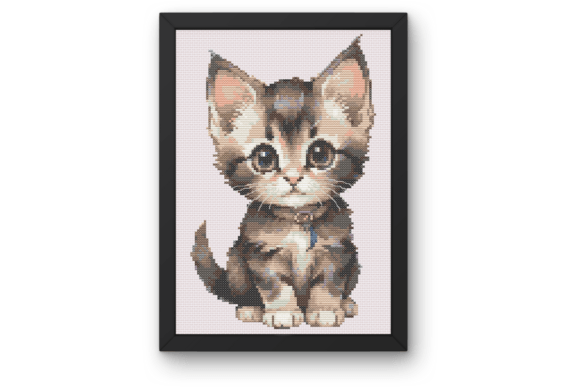
Watercolour Cute Kitten Cross Stitch
First Impression: Soft, Playful, and Instantly Approachable
As an embroidery designer who’s curated over 200 craft fair booths in the past decade, my gut reaction to Watercolour Cute Kitten Cross Stitch is immediate: it reads as gentle, joyful, and quietly confident—not cloying, not overly detailed, and definitely not generic. The “watercolour” cue signals soft edges and subtle blending, while “cute kitten” promises charm without saccharine overload. It lands firmly in the sweet spot between modern handmade and timeless cottagecore—ideal for shoppers scanning a crowded market aisle at 11 a.m. on a Saturday. It doesn’t shout; it invites. That matters more than you think when your booth has three competing pastel tote bags and a line forming by the lemonade stand.
Where This Design Shines On Craft Fair Products
Tote bags: At approx 6 × 9.25 inches on 14-count Aida, Watercolour Cute Kitten Cross Stitch scales beautifully to a medium-to-large front panel—centered just below the handles or nestled in the lower corner with intentional negative space. It reads clearly from 3 feet away, especially on natural canvas or oat linen, and feels premium next to mass-printed alternatives.
Aprons and tea towels: This design thrives on vertical real estate. On a bib apron, it anchors the chest area with warmth and personality. On a flour-sack tea towel, it becomes a focal point that balances utility and whimsy—perfect for gifting or boutique shelf appeal. Its whole-stitch + backstitch structure ensures crisp definition even after repeated washing (when properly finished).
Patches and pouches: While the full pattern is best appreciated at its native size, key elements—a single paw, the kitten’s eye, or a simplified outline—can be extracted for embroidered patches or small fabric pouches. That adaptability makes Watercolour Cute Kitten Cross Stitch more than a one-off; it’s a design asset with modular potential.
Pillow covers and caps: Use caution here. The 82 × 130 stitch count translates to under 7 inches wide—too large for most curved cap fronts without distortion, and potentially overwhelming on a 12-inch square pillow unless balanced with solid-color backing or tonal piping. For caps, consider a cropped version; for pillows, pair it with coordinating cross-stitched borders or botanical corners.
What Makes It Sell—And What Requires Care
This pattern earns trust fast. The black-and-white symbol chart is intuitive for intermediate stitchers—no color confusion, no ambiguous symbols—and the reliance on whole stitches (plus minimal backstitch) means consistent rhythm and fewer dropped threads during production. That directly supports batch work for small shop owners prepping 15–20 tote bags before a fair weekend.
Photography is a quiet strength: the soft watercolour aesthetic renders beautifully in natural light, and the contrast between black floss and white Aida creates clean, Etsy-friendly mockups—even on printable mockup templates. It performs well across digital touchpoints: thumbnails, Instagram carousels, and printed booth signage.
But attention is needed where delicacy meets practicality. Tiny facial features (like whiskers or pupils) may blur on textured tea towels or thick denim tote bases. Avoid stitching Watercolour Cute Kitten Cross Stitch directly onto dark fabric without testing thread contrast first—DMC black on charcoal won’t pop. Likewise, dense stitch areas (around the kitten’s fur contour or inner ear) benefit from light stabilizer backing on loosely woven fabrics to prevent puckering.
Design Integrity Meets Booth Impact
In person, this pattern elevates perceived handmade quality—not because it’s technically complex, but because it *feels* intentional. Customers pause longer at pieces featuring Watercolour Cute Kitten Cross Stitch, especially when stitched with care: even tension, smooth floss transitions, and thoughtful framing (e.g., a hand-stitched border on a pillow cover). That pause converts. It reinforces brand consistency for makers who lean into soft illustration, nature-adjacent themes, or mindful making.
On a crowded craft fair table, it stands out without competing—unlike neon geometric patterns or highly saturated florals. It pairs effortlessly with neutral displays: wooden crates, linen napkins, dried lavender bundles. And crucially, it encourages engagement: customers ask, “Is that hand-stitched?” “Do you do custom colors?” “Can I get this on a mug?”—opening doors to upsells and repeat orders.
Practical Designer Notes Before You Stitch & Sell
- Always test on scrap fabric matching your final product’s weight and texture—especially for tea towels and aprons.
- Check thread contrast under both daylight and indoor lighting; DMC black behaves differently on off-white vs. bright white Aida.
- Review spacing and proportion when transferring to curved or tapered surfaces (like market bag gussets or apron pockets).
- Confirm hoop size compatibility: A 6 × 9.25-inch stitched area fits comfortably in a 8-inch hoop—but verify clearance if using a slotted or low-profile frame.
- Inspect stitch density in high-detail zones (e.g., the kitten’s face); adjust floss strand count (2-strand vs. 3-strand) to maintain clarity on textured surfaces.
- Use appropriate stabilizer for stretchy or unstable fabrics—tear-away works well for cotton totes; cut-away adds durability for frequently washed items like aprons.
- Create at least one real mockup before bulk production—not just a digital preview, but a stitched, finished sample held in natural light.
- Compare fabric colors side-by-side: ivory, oat, ecru, and natural vary widely in warmth and value; the kitten’s softness shifts dramatically across them.
- Verify commercial licensing before selling finished products—this is a PDF download pattern; confirm whether personal-use-only or small-batch commercial rights apply.
Final Thought for Sellers and Makers
Watercolour Cute Kitten Cross Stitch isn’t just another cross stitch pattern—it’s a versatile, emotionally resonant design asset. In the world of Cross Stitch Patterns and hand-crafted Graphics, it bridges accessibility and artistry. It sells because it feels human: tender but not fragile, simple but not sparse, nostalgic but never dated. For Etsy sellers, boutique makers, and craft fair veterans alike, it’s proof that sometimes the quietest designs make the loudest impression—especially when stitched with intention, displayed with care, and shared with heart.