Colorful Geometric Star Cross Stitch
A Designer’s First Glance: Bold, Playful, and Purposefully Simple
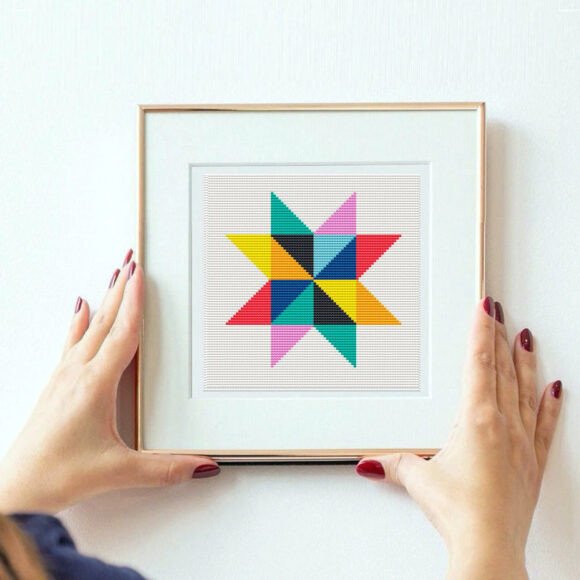
When I opened the Colorful Geometric Star Cross Stitch pattern, my immediate reaction wasn’t “cute” or “trendy”—it was “usable.” That’s rare. The star isn’t fussy or overly symmetrical; it leans into joyful asymmetry, with triangular segments arranged like a kaleidoscope frozen mid-spin. It feels modern without being cold—there’s warmth in the color transitions, even though it’s a graphics-based cross stitch pattern. No florals, no script, no vintage motifs. Just clean geometry, saturated but balanced tones, and a shape that reads instantly at small scale. That tells me it’ll hold up on a baby onesie chest pocket or as a subtle accent on a linen tea towel.
Real-World Test: Stitching It Onto a Linen Tote Bag for a Boutique Launch
Last week, I stitched the Colorful Geometric Star Cross Stitch onto a natural linen tote for a local boutique’s summer collection. Why this design? Because their customers respond to handmade items that feel intentional—not just decorative, but *designed*. The star sat cleanly centered on the front panel, about 3.5 inches wide. No crowding, no awkward negative space. On linen, the cross stitch texture enhanced the fabric’s organic grain instead of fighting it. Customers paused at the display—not because it shouted, but because it invited closer looking. One asked, “Is that hand-drawn?” (It’s not—but the pattern’s rhythm and spacing gave it that human-made confidence.) That’s the quiet power of this piece: it doesn’t need embellishment to feel special.
Where It Shines—and Where It Needs Thought
The Colorful Geometric Star Cross Stitch excels in projects where clarity and charm matter more than complexity:
- Custom apparel: Works beautifully on sweatshirt chests, t-shirt yokes, and cap backs—especially when you want a pop of personality without overwhelming the garment.
- Baby embroidery: Soft colors and open layout mean it won’t look too busy on onesies or burp cloths. No tiny details that blur after washing.
- Embroidered patches: Its defined edges and moderate density make it ideal for iron-on or sew-on patches—no fraying risk in the corners.
- Holiday and wedding gifts: Not seasonal, but timeless enough for baby showers, housewarmings, or teacher appreciation—especially when paired with neutral fabrics.
- Etsy listings and craft fair products: Stands out in thumbnail previews and translates well to printable mockups. Buyers recognize its versatility immediately.
But be mindful: this isn’t a one-size-fits-all workhorse. Avoid using it on highly textured fabrics (like bouclé or heavy terry) unless you’ve tested stabilizer layers first. On stretchy knits, the geometric lines can distort if hooping isn’t precise. And while it reads well on dark fabric, verify thread color contrast—some vibrant hues may mute against charcoal or navy unless you adjust your palette intentionally.
Design Integrity Meets Commercial Practicality
As someone who reviews hundreds of cross stitch patterns yearly, I notice how often “colorful” designs sacrifice legibility for saturation. Not here. Each triangular segment has breathing room. Stitch density feels even—not so dense it gums up lightweight cotton, not so sparse it looks unfinished on heavier canvas. That balance directly affects product value: a well-stitched Colorful Geometric Star Cross Stitch elevates a basic pillow cover into a boutique-ready item. It signals care, not just craft. For Etsy sellers and small shop owners, that perception builds customer trust faster than any description ever could.
It also supports brand consistency. If your shop leans minimalist, playful, or modern-organic, this pattern fits right in—no rebranding needed. And because it’s graphics-based (not illustrative or typographic), it scales cleanly across product types: from a tiny embroidered tag on a handmade soap wrap to a bold repeat on a kitchen towel set.
Practical Designer Notes Before You Stitch
Before committing to a client project or production run, do these five things:
- Test on scrap fabric—same weight and weave as your final piece. Linen behaves differently than Aida, and cotton twill reacts differently than fleece.
- Check thread color contrast on both light and dark backgrounds. Print a black-and-white version to assess tonal separation—what looks vivid on screen may flatten in thread.
- Review stitch density in the tightest zones (like inner star points). If your machine struggles with dense fills, consider simplifying one or two segments manually—or confirm the file allows easy editing.
- Confirm hoop size compatibility. This design likely fits comfortably in a 4x4 hoop, but always measure before digitizing or prepping fabric.
- Verify licensing. Since it’s listed under Cross Stitch Patterns and Graphics, clarify whether commercial use is permitted for finished handmade products—or if resale of the digital embroidery file itself requires separate permission.
Final Thought: A Pattern That Earns Its Place
The Colorful Geometric Star Cross Stitch isn’t flashy. It doesn’t try to be everything. It’s a focused, confident design—built for real making, not just pretty previews. Whether you’re stitching a personalized gift, launching a small batch of embroidered aprons, or building a cohesive line of nursery decor, it adds energy without chaos. It reminds me why I love this craft: sometimes, the strongest statement is a single, well-placed star—bright, clear, and unmistakably handmade.